I like dirt. I don't know why - maybe it's just a thing. One of Chrissie's favorite anecdotes is that the part of the garden that I was most enamored with when we bought the house was the composting. Not the fruit trees, herbs, or veggies, but the composting. Yeah, I was pretty intent of getting started right away, and yeah, I'm still trying to talk Chrissie into starting a third compost garbage can. I'm into compost because I know that if you want to grow good food, you have to give it the right conditions. Good sun, sufficient water, and good dirt.
Composting is pretty darn easy. That's because you're just letting nature do its thing. The "art" of it involoves managing the process so that it happens in the quickest way possible. I'm not going to tell you how to do it in this blog. There are a ton of places you can go to for that information. For you lazy searchers out there go here. That'll get you started. I will talk about little tips I've picked up here and there and relay funny stories involving our compost.
I am of the opinion that anyone who grows stuff should compost. Even if the "stuff" is just a lawn. It's not because I'm on a crusade to turn everyone into linen-wearing tree-huggers, but because it makes a lot of sense. Creating your own compost saves you from having to go out and buy dirt or fertilizer all of the time. This ultimately means you are saving money. It also saves you money on the other end by reducing the amount of garbage you have taken away.
To give a concrete example, the amount of composting we do equals about half a cubic yard every year. If I were to buy that at my local nursery, that would be about $20.00. On the garbage side, Chrissie and I can skate by using the smallest size garbage can and we do not need a yard waste bin. That is a savings of $60.00 a quarter. $20 of it being the difference between the small garbage can and the next size up, and $40 being the cost of using a yard waste bin. $260 saved. It's modest, but I think it's pretty great because I just got $260 from garbage.
I think that the other thing about composting that appeals to me is that it makes me feel more connected to the land that I'm living on. I feel that way because I take part in shaping and creating it. It's a good feeling to have. It's real and there's a sense of permanence about it. So, even if Chrissie and I leave this place one day, I'll know that I left this place better than I got it, and maybe, some of what we've done will stick around and thrive.

Friday, July 8, 2011

Wednesday, July 6, 2011
Eating Red, White, and Blue
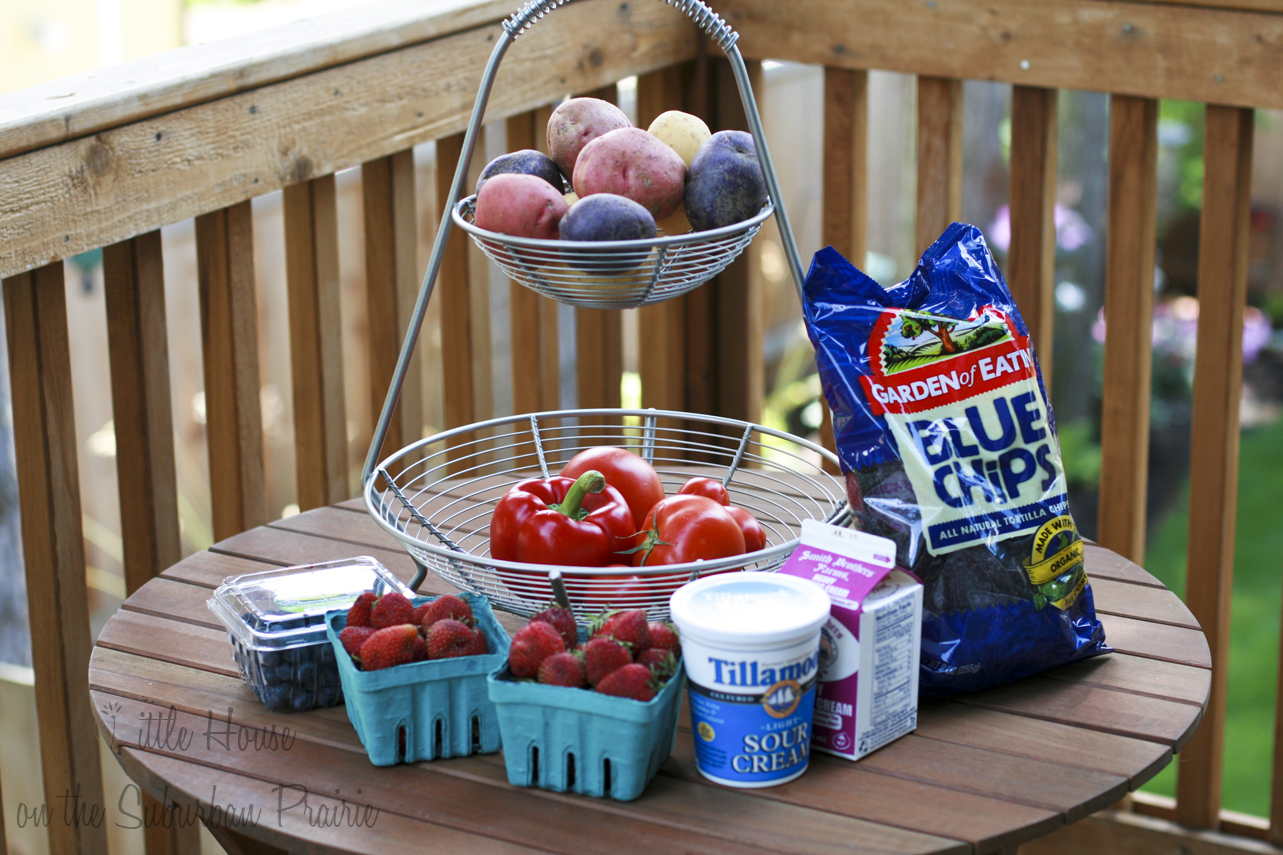
As you may have guessed, Aaron and I decided to have a little fun with our food on Independence Day so we tried to make sure as much as possible that day that what we were eating was red, white, and/or blue. We wanted to stay away from the stereotypical strawberry/blueberry flag cake, so we had to get a little creative. There just aren't many blue foods out there! Here's what we came up with:
Blue chips, Red Salsa, Sour Cream
We didn't make much of this one, though I'm sure we could have. We made the salsa from scratch, but we weren't able to get to the farmer's market and while the tomatoes at PCC were decent, the season for them around here is really just beginning. The recipe for our mild red salsa:
2 heirloom or vine tomatoes (peeled, seeded, and diced)
2-3 small roma tomatoes (peeled, seeded, and diced)
3/4 of a red pepper (cored and diced)
7-8 stems of cilantro (chopped)
A dash of lemon juice
Salt and pepper to taste

Red, White, and Blue Rosemary Potatoes
I was originally intending to make these crispier but I boiled them a little too long and used more potatoes than my pan could handle. They turned out quite nicely anyway, so here's what we did:
Boil 3 potatoes of each variety (small varieties work best, we used Yukon Golds, Baby Reds, and Peruvian Purple) cut into approximately 1 - 1.5 inch cubes for about 10 minutes. Or until they're slightly less tender than they look above.
Heat 1/4 cup olive oil in a pan over medium-high heat when your potatoes are about 3 minutes away from being finished boiling.
When the potatoes are tender in the water, drain them. If the oil is sufficiently heated, add the potatoes to the oil.
If you're like me, your potatoes won't all be able to reach the heat source, so you'll need to periodically stir them around to ensure that all the potatoes get some chance at being cooked. Don't stir them too much, or none of them will get crispy on the outside at all.
Once the potatoes look tasty, add about 2 teaspoons of fresh, chopped rosemary (1 teaspoon dried) and salt and pepper to taste. Cook for about 5 more minutes, then serve straight from the pan.

Grilled Strawberry Shortcake Kebabs
We found this recipe originally in Sunset Magazine, but made some adaptations for our taste. Sunset suggested using Angel Food cake, but neither of us prefer that so we made a fresh pound cake that morning. For the topping, Sunset also suggested using a combination of crème fraîche, whipped cream, brown sugar, and lemon zest, but we wanted something a little more simple, so we stuck with homemade whipped cream. All in all, we really enjoyed what we came up with, so here is our adaptation.
2 Slices of Pound Cake
8 Strawberries
2 Tablespoons Strawberry Jam
1/2 cup freshly made whipped cream
Heat the jam in the microwave just long enough so that it starts bubbling and coat your hulled strawberries with it. (We happened to have strawberry jam that was just made a week ago by my co-worker. I think this was a major plus.) Cut the pound cake slices into cubes. Double up the skewers for stability and thread approximately 4 strawberries and 3 pieces of pound cake onto each one. (As you can see, we had varying sizes of strawberry.) Place the skewers onto a relatively low-heat grill (approximately 350 degrees) for about 2 minutes per side. We tried to cook all four sides rather than just the 2 suggested by Sunset, but it might be different with Angel Food Cake. When the cake (and hopefully the strawberries) are lightly grilled on all sides, take them off and serve with the whipped cream!
We realize that our dessert did not have any blue. We had intended to make some blueberry fools to remedy that situation, but we were too full, too tired, and ready to watch some fireworks. So, the blue dessert will have to be saved for another day.
 |
We didn't make much of this one, though I'm sure we could have. We made the salsa from scratch, but we weren't able to get to the farmer's market and while the tomatoes at PCC were decent, the season for them around here is really just beginning. The recipe for our mild red salsa:
2 heirloom or vine tomatoes (peeled, seeded, and diced)
2-3 small roma tomatoes (peeled, seeded, and diced)
3/4 of a red pepper (cored and diced)
7-8 stems of cilantro (chopped)
A dash of lemon juice
Salt and pepper to taste

Red, White, and Blue Rosemary Potatoes
I was originally intending to make these crispier but I boiled them a little too long and used more potatoes than my pan could handle. They turned out quite nicely anyway, so here's what we did:
Boil 3 potatoes of each variety (small varieties work best, we used Yukon Golds, Baby Reds, and Peruvian Purple) cut into approximately 1 - 1.5 inch cubes for about 10 minutes. Or until they're slightly less tender than they look above.
Heat 1/4 cup olive oil in a pan over medium-high heat when your potatoes are about 3 minutes away from being finished boiling.
When the potatoes are tender in the water, drain them. If the oil is sufficiently heated, add the potatoes to the oil.
If you're like me, your potatoes won't all be able to reach the heat source, so you'll need to periodically stir them around to ensure that all the potatoes get some chance at being cooked. Don't stir them too much, or none of them will get crispy on the outside at all.
Once the potatoes look tasty, add about 2 teaspoons of fresh, chopped rosemary (1 teaspoon dried) and salt and pepper to taste. Cook for about 5 more minutes, then serve straight from the pan.

Grilled Strawberry Shortcake Kebabs
We found this recipe originally in Sunset Magazine, but made some adaptations for our taste. Sunset suggested using Angel Food cake, but neither of us prefer that so we made a fresh pound cake that morning. For the topping, Sunset also suggested using a combination of crème fraîche, whipped cream, brown sugar, and lemon zest, but we wanted something a little more simple, so we stuck with homemade whipped cream. All in all, we really enjoyed what we came up with, so here is our adaptation.
2 Slices of Pound Cake
8 Strawberries
2 Tablespoons Strawberry Jam
1/2 cup freshly made whipped cream
Heat the jam in the microwave just long enough so that it starts bubbling and coat your hulled strawberries with it. (We happened to have strawberry jam that was just made a week ago by my co-worker. I think this was a major plus.) Cut the pound cake slices into cubes. Double up the skewers for stability and thread approximately 4 strawberries and 3 pieces of pound cake onto each one. (As you can see, we had varying sizes of strawberry.) Place the skewers onto a relatively low-heat grill (approximately 350 degrees) for about 2 minutes per side. We tried to cook all four sides rather than just the 2 suggested by Sunset, but it might be different with Angel Food Cake. When the cake (and hopefully the strawberries) are lightly grilled on all sides, take them off and serve with the whipped cream!
We realize that our dessert did not have any blue. We had intended to make some blueberry fools to remedy that situation, but we were too full, too tired, and ready to watch some fireworks. So, the blue dessert will have to be saved for another day.
Monday, July 4, 2011
Sunday, July 3, 2011
Miscellany
Here are some small projects I've been doing around the house to keep myself busy. None of them are big enough to warrant a post on their own, but they're still worth mentioning.
Kelp
Chrissie and I took our dog, Helo, to the dog park last week and I spotted a bunch of kelp on the beach. If you were wondering, yes, there is a beach dog park close to where we live. It's actually kind of commonplace around Seattle. Kelp is great for compost and gardens to I filled a plastic bag with as much as I could fit and dumped it into the compost.

Kelp is great compost material. It is packed with a diverse amount of nutrients and minerals. It's possible for people to eat it and it's really good for you. It's considered a "super-food." I've eaten seaweed and kelp before, but seeing as this stuff came from the dog park, I didn't really trust it. It was, however, good enough to throw into the compost.
Another good thing you can do with kelp in your garden is to just insert it into the soil. It will give your soil a really quick boost of goodness. Some plants, like green beans, do much better when planted with kelp around it. If you're skeptical that kelp is good for your garden, go look at the ingredients label of an organic fertilizer. The first ingredient is probably kelp.
Rust
We found some orange spots on the leaves of the "normal" pear tree today. They looked a little suspicious, so I looked up what could be wrong on the internet. Rust, the common name for this kind of fungal infection, came back as the likely issue, and a quick call to our local nursery confirmed it.

Rust isn't actually that bad. First off, it doesn't kill the host. Second, it doesn't infect the fruit. A plant with rust will get on fairly well and you probably won't notice much of a difference in your harvest. Me, I don't want to take any chances. I want to do as much as I can to minimize the stress on the trees.
The bad news is that rust isn't something that you can totally kill off, but you can just manage it pretty easily. Fungicides are quite ineffective at killing it after it gets on the tree. They are most effective at preventing the rust from inhabiting the tree in the first place. Getting rid of rust from an infected tree means removing all of the "rusty" leaves and throwing them away. Note - do not compost them! So that's what I did this morning and I'll keep an eye on the other trees as rust can infect them also.
I did wonder why the Charlie-Brown-Pear-Tree didn't get infected at all and I believe it's because of the sulfer spray we applied to it a couple of weeks ago. Not only does the sulfer kill bacteria, it kills fungus too, exactly the way I mentioned above - by preventing anything from establishing itself in the first place. Literally, as soon as the rust spores came in contact with the tree, the sulfer burned it right off. Nasty stuff.
Kelp
Chrissie and I took our dog, Helo, to the dog park last week and I spotted a bunch of kelp on the beach. If you were wondering, yes, there is a beach dog park close to where we live. It's actually kind of commonplace around Seattle. Kelp is great for compost and gardens to I filled a plastic bag with as much as I could fit and dumped it into the compost.

Kelp is great compost material. It is packed with a diverse amount of nutrients and minerals. It's possible for people to eat it and it's really good for you. It's considered a "super-food." I've eaten seaweed and kelp before, but seeing as this stuff came from the dog park, I didn't really trust it. It was, however, good enough to throw into the compost.
Another good thing you can do with kelp in your garden is to just insert it into the soil. It will give your soil a really quick boost of goodness. Some plants, like green beans, do much better when planted with kelp around it. If you're skeptical that kelp is good for your garden, go look at the ingredients label of an organic fertilizer. The first ingredient is probably kelp.
Rust
We found some orange spots on the leaves of the "normal" pear tree today. They looked a little suspicious, so I looked up what could be wrong on the internet. Rust, the common name for this kind of fungal infection, came back as the likely issue, and a quick call to our local nursery confirmed it.

Rust isn't actually that bad. First off, it doesn't kill the host. Second, it doesn't infect the fruit. A plant with rust will get on fairly well and you probably won't notice much of a difference in your harvest. Me, I don't want to take any chances. I want to do as much as I can to minimize the stress on the trees.
The bad news is that rust isn't something that you can totally kill off, but you can just manage it pretty easily. Fungicides are quite ineffective at killing it after it gets on the tree. They are most effective at preventing the rust from inhabiting the tree in the first place. Getting rid of rust from an infected tree means removing all of the "rusty" leaves and throwing them away. Note - do not compost them! So that's what I did this morning and I'll keep an eye on the other trees as rust can infect them also.
I did wonder why the Charlie-Brown-Pear-Tree didn't get infected at all and I believe it's because of the sulfer spray we applied to it a couple of weeks ago. Not only does the sulfer kill bacteria, it kills fungus too, exactly the way I mentioned above - by preventing anything from establishing itself in the first place. Literally, as soon as the rust spores came in contact with the tree, the sulfer burned it right off. Nasty stuff.
Thursday, June 30, 2011
Cookbook Winner!
Thanks to everyone who entered our contest for a copy of How to Cook Everything! It's been great getting new followers and hearing from everyone who is enjoying our blog. We're having a great time with it.
The winner, based on a random draw from random.org is....
Brian Madsen!
Congratulations, Brian! Contact us at oursuburbanprairie at gmail dot com to claim your prize.
For the rest of you, have no fear. We'll continue posting adaptations of our favorite recipes here. Not only from this cookbook, but from many others as well.
Happy reading!
The winner, based on a random draw from random.org is....
Brian Madsen!
Congratulations, Brian! Contact us at oursuburbanprairie at gmail dot com to claim your prize.
For the rest of you, have no fear. We'll continue posting adaptations of our favorite recipes here. Not only from this cookbook, but from many others as well.
Happy reading!
Wednesday, June 29, 2011
Food Tourist part 2
I'm a self-ascribed vegetarian tourist. I love taking periodic trips to Veggie land (I try not to stray off the road into Vegan land though), taking in some of the sights, and then coming home to my normal life. In fact, I'm a regular. I probably do it a few times a month. The trips are pretty short though - only for a day or two. That's enough for me though. I'm happy just visiting. I don't want to live there, but I wouldn't mind if they knew me on a first-name basis. I call it "tourism" because to me, it's just that. You're there to see the sights, take a break from your normal life, and then head home when you're all done. It's just more symbolic than literal.
Good things can happen as a result too if you let them. Whenever I travel, I find that I see myself from a different perspective during and after the trip. This in turn usually gives me a moment of self-realization, which can be followed by self-improvement (if I feel like it). I also find that my horizon expands, which leads to incorporating new things back in my "normal life."
The same thing can happen with trying out a new food lifestyle. I think that the biggest change I've experienced so far is that I notice a lot more foods. It's definitely been a gradual process. Each new "trip" has added a new level of awareness. In the beginning, after I started cooking seriously for myself, I started to notice the parts of the grocery store that were not processed foods. Then, I began to see the difference in quality of food. Vegetarianism opened up my awareness to more vegetables (duh). French cooking exposed me a huge amount of things one can do with butter, cream, and eggs. The Raw Food trend made me aware of edible wild plants (aka weeds). The list goes on and on.
Our one Raw Food "trip" so far was pretty miserable, though Chrissie and I can laugh about it now. We went on a 5 day smoothie/raw food cleanse. You actually have a lot of options for raw food, but we ended up going smoothies because we thought it had the highest probability of success. We piled up a bunch of fruit, veggies, and juice on Sunday and planned to go Monday through Friday on the diet. I didn't even last a day. I couldn't handle having nothing but smoothies. Tuesday, I started going out for lunch, but I still did smoothies for breakfast and dinner with Chrissie. That definitely stung me with shame and self-loathing. I felt like one of those tourists that goes to a foreign country and eats at McDonald's.
Chrissie was a trooper and finished the diet, although she was miserable the entire time. After a while, she didn't even bother having dinner. I think that happened in a couple days. She just couldn't consume that much smoothie. So, in the end, her tact was the opposite of mine. Instead of being a cheater tourist, she was a starving tourist. I think she lost 5 pounds in the end.
From the experience, I learned that taking smoothies is a great way to get your fruits and veggies. The ingredients aren't cooked so they retain all of their nutritional value and it doesn't take a lot to hit your daily allotment of fruits and vegetables. It's my plan to make these for breakfast one day... once we're totally over the shock of the smoothie cleanse experience. Until then, we'll keep things the way things are - vegetables cooked and fruit whole.
Good things can happen as a result too if you let them. Whenever I travel, I find that I see myself from a different perspective during and after the trip. This in turn usually gives me a moment of self-realization, which can be followed by self-improvement (if I feel like it). I also find that my horizon expands, which leads to incorporating new things back in my "normal life."
The same thing can happen with trying out a new food lifestyle. I think that the biggest change I've experienced so far is that I notice a lot more foods. It's definitely been a gradual process. Each new "trip" has added a new level of awareness. In the beginning, after I started cooking seriously for myself, I started to notice the parts of the grocery store that were not processed foods. Then, I began to see the difference in quality of food. Vegetarianism opened up my awareness to more vegetables (duh). French cooking exposed me a huge amount of things one can do with butter, cream, and eggs. The Raw Food trend made me aware of edible wild plants (aka weeds). The list goes on and on.
Our one Raw Food "trip" so far was pretty miserable, though Chrissie and I can laugh about it now. We went on a 5 day smoothie/raw food cleanse. You actually have a lot of options for raw food, but we ended up going smoothies because we thought it had the highest probability of success. We piled up a bunch of fruit, veggies, and juice on Sunday and planned to go Monday through Friday on the diet. I didn't even last a day. I couldn't handle having nothing but smoothies. Tuesday, I started going out for lunch, but I still did smoothies for breakfast and dinner with Chrissie. That definitely stung me with shame and self-loathing. I felt like one of those tourists that goes to a foreign country and eats at McDonald's.
Chrissie was a trooper and finished the diet, although she was miserable the entire time. After a while, she didn't even bother having dinner. I think that happened in a couple days. She just couldn't consume that much smoothie. So, in the end, her tact was the opposite of mine. Instead of being a cheater tourist, she was a starving tourist. I think she lost 5 pounds in the end.
From the experience, I learned that taking smoothies is a great way to get your fruits and veggies. The ingredients aren't cooked so they retain all of their nutritional value and it doesn't take a lot to hit your daily allotment of fruits and vegetables. It's my plan to make these for breakfast one day... once we're totally over the shock of the smoothie cleanse experience. Until then, we'll keep things the way things are - vegetables cooked and fruit whole.
Monday, June 27, 2011
A Strawberry Weekend Pt. 3
As quickly as we tried to consume our strawberries, we still lost some to over-ripening and mold. So that Sunday we used what was left to make strawberry shortcakes. I love strawberry shortcake. As I mentioned in part one, it's pretty hard to go wrong with strawberries and whipped cream and throwing a little cake or sweet pastry in there is no exception.
We decided to make strawberry short cake with butter scones and homemade whipped cream (which is what our buddy-on-the-cookbook-page, Mark Bittman, suggested). They were absolutely delightful. We had extra scones since we made a full batch of those, but only had enough strawberries for a half batch of shortcakes. My waistline was thankful. You can probably see why:


If you'd like to make some of these yourself, don't forget to enter our giveaway for the cookbook!
We decided to make strawberry short cake with butter scones and homemade whipped cream (which is what our buddy-on-the-cookbook-page, Mark Bittman, suggested). They were absolutely delightful. We had extra scones since we made a full batch of those, but only had enough strawberries for a half batch of shortcakes. My waistline was thankful. You can probably see why:


If you'd like to make some of these yourself, don't forget to enter our giveaway for the cookbook!
Subscribe to:
Posts (Atom)